



















![The market-builder who restrained the market [Part 2]](https://muslimviews.co.za/wp-content/uploads/2026/08/PHOTO-2026-08-25-17-16-32-360x180.jpg)
![The merchant preceding the Prophetic mission [Part 1]](https://muslimviews.co.za/wp-content/uploads/2026/08/01-360x180.jpg)








‘What does prophetic courage look like today? What would Imam Gassan Solomon ask of us now – in the face of deepening injustice, inequality, and spiritual malaise? Let us each take a moment to ask: what legacy are we building?’
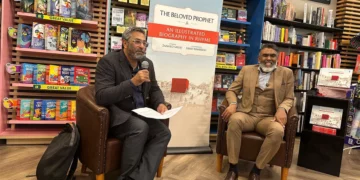
PROFESSOR ASLAM FATAAR delivering his keynote address at the launch of Echoes of Freedom: The Story of Imam Gassan Solomon by Faseeg Manie at the Homecoming Centre in District Six, Cape Town on Saturday April 12, 2025.

It is with reverence and joy that we gather here today to honour a life of consequence – and to launch a powerful book.
This is no ordinary biography. It is a work of kinship and political courage – a communion across generations.
Though writer and subject never met, they are bonded by a family lineage to Tuan Guru, one of the architects of Islam at the Cape. From Tuan Guru’s prison cell to Imam Gassan’s activism to Faseeg’s pen to us, we trace a long arc of sacred defiance – a genealogy of moral clarity and struggle.
Faseeg began this project in early 2024, nudged by a friend and Imam Gassan’s brother. What followed was an act of researching, remembering and composing that summoned the presence of Imam Gassan in a profound way.
Imam Gassan’s integration of faith and activism reverberates through these pages. His life became the compass that awakened in Faseeg a remarkable literary and research capacity. Supported by his wife Rhoda, Faseeg – a retired educator, principal and ace chess player – did the arduous work of remembrance, giving form to a legacy that called out to be told.
Having walked this path alongside Faseeg, I honour his humility, steadfast devotion, and his reverence for this sacred labour. It is rare to witness someone embrace a story not their own, and yet allow it to shape and transform them until it becomes wholly theirs.

Imam Gassan Solomon was a man of Allah and a man of Allah’s justice. During the brutal 1980s, he stood unflinching – raising his voice at rallies, leading marches, evading security forces, and facing the ever-present threat of arrest and torture.
His politics were never a matter of convenience, but a response to the Quranic imperative: ‘Stand firmly for justice, as witnesses to Allah’ (Sūrat al-Nisāʾ, 4:135).
When others in the Muslim leadership chose silence he chose defiance. His actions bore consequence. Yet he did not waver.
He was shaped by a rich network of family, institutions, companions, teachers, and comrades. His early formation included schooling at Constantia Primary and South Peninsula High, followed by tertiary studies at the University of Cape Town, Peninsula Technikon, and Umm al-Qurā University in Makkah during his years in exile.
His working life included roles at South African Nylon Spinners, Lansdowne Textile Industries, the South African National Zakah Fund, the Muslim Judicial Council, his tenure as Imam at Claremont Main Road Masjid, and as an ANC member of parliament.
His political and Islamic commitments were informed by a confluence of ideological and organisational influences, including the Unity Movement, the Pan African Congress, and the Muslim Youth Movement of South Africa, as well as through leadership roles in the Call of Islam, the Muslim Judicial Council, the United Democratic Front, and the African National Congress. These affiliations played a critical role in shaping his ethical-political orientation and activism.
Equally formative were the presence of his father, mother, and siblings, wives and children; mentorship figures such as Imam Abdullah Haron, Shaikh Salih Dien, and Shaikh Shaakir Gamieldien and friendship of Ebrahim Bardien, brother-in-law Shaikh Faaik Gamieldien, Imam Rashied Omar, Professor Farid Esack and bosom friend M S Kagee – all of whom nourished and shaped his being.
Imam Gassan read profusely. He soaked up Quranic teachings and Prophetic wisdom, turning it into bold, purposeful action. He shaped a South African Muslim vision of human rights that still resonates today. His struggle was grounded in the everyday realities of ordinary people – the black poor, workers, women and unemployed; those left on the margins.
Through his words and deeds, he built bridges across cultures, communities, and faiths, showing us that solidarity isn’t a slogan, it’s a sacred duty.
He made dear sacrifice: Escape, Exile, Family Separation. Yet even from afar – even from the sands of Saudi Arabia where he lived in exile – he remained tethered to his people, slipping back to energise the underground with acts of liberation.
What does prophetic courage look like today? What would Imam Gassan ask of us now – in the face of deepening injustice, inequality, and spiritual malaise? Let us each take a moment to ask: what legacy are we building?

Faseeg’s narration brings this all to life – tracing Imam Gassan’s Constantia roots, the trauma of forced removal, his activism in Grassy Park and the enduring Solomon legacy of piety, dignity, and solidarity.
Imam Gassan embodied prophetic courage and intellectual lucidity. Slight in frame, soft in voice – yet when he stood to speak, he thundered. His words soared and stirred souls.
Let Echoes of Freedom stir us – not only to remember – but to act; to walk in the light of Imam Gassan’s example, to heed the call so tenderly carried by Faseeg’s pen.
May Allah elevate Imam Gassan’s rūḥ and grant him a high station in al-Jannah. May Allah bless Faseeg for this noble act of remembrance.
You may also want to read


- Echoes of Freedom: The Story of Imam Gassan Solomon by Faseeg Manie is published by Chiron Media, Cape Town. The book can currently be ordered from: info@igsfoundation.org.za


