


















![The market-builder who restrained the market [Part 2]](https://muslimviews.co.za/wp-content/uploads/2026/08/PHOTO-2026-08-25-17-16-32-360x180.jpg)
![The merchant preceding the Prophetic mission [Part 1]](https://muslimviews.co.za/wp-content/uploads/2026/08/01-360x180.jpg)






With the celebration of Eid ul-Fitr, this reflection explores how the Ummah can move from hardship to hope through unity, resilience, and spiritual renewal.
By MOULANA SAYED IMRAAN SHAH ZIYAEE
As the crescent moon prepares to grace the horizon, marking the end of the sacred month of Ramadan, the celebration of thanksgiving after a month of sacrifice for Allah Almighty fulfils the Pillar of Islam.
Eid ul-Fitr is traditionally a day of high-spirited celebration, fine clothes and shared feasts, yet this year, as we approach this upcoming edition of our festivities, the air carries a weight that cannot be ignored.
From the humanitarian crises in Gaza and Sudan to the rising tide of global economic instability and Islamophobia, the Ummah (nation) is navigating a season of profound testing.
However, the essence of Eid is not the absence of hardship, but the triumph of the spirit over it. It is a celebration of Taqwa (God-consciousness) polished in the furnace of discipline.
We live in an era of unprecedented connectivity yet deep fragmentation. While we can see the suffering of our brothers and sisters across the globe in real time, the feeling of helplessness can be paralysing.
The Prophet Muhammad (peace be upon him) famously described the Ummah as a single body: ‘The parable of the believers in their affection, mercy and compassion for each other is that of a body. When any limb aches, the whole body reacts with sleeplessness and fever.’ (Sahih Bukhari)
Today, the body is in a state of fever. The challenges we face are not merely external or political; they are psychological and spiritual. We face a ‘crisis of hope’. When the world feels fractured, the ritual of Eid – the communal prayer (Salaat al-Eid), the mandatory charity (Zakat al-Fitr) and the embrace of a neighbour – serves as a divine recalibration. It reminds us that our strength lies in solidarity, not just sentiment.
In the Sufi tradition, the external Eid is but a shadow of the ‘internal Eid’. As the Sultan of Saints, Shaykh Abdul Qadir al-Jilani (RA), taught in his discourses, the true fast is the fasting of the heart from everything other than the Divine. He reminded his seekers that the believer is in a constant state of struggle with the lower self (Nafs). If Ramadan was the season of exertion, then Eid is the Fath (opening).
This concept of resilience is perfectly embodied in the person of Sayyidina Ali (may Allah be pleased with him), the ‘Gate to the City of Knowledge’. He taught us that the Ummah’s strength is found in Yaqeen (certainty). He famously remarked: ‘Patience is to faith like a head to a body. If the head is cut, the body will perish.’
For an Ummah currently facing contraction, Sayyidina Ali’s life serves as a blueprint for Futuwwa, spiritual courage. He demonstrated that even in the darkest hours, the believer remains ‘a lion by day and a monk by night’.
You may also want to read


This dual nature – being fiercely committed to justice while remaining tranquil in the presence of Allah Almighty – is exactly what is required of us today. When we celebrate Eid, we are refuelling our spirits with the same sincerity that the saints used to transform their societies. One should remain pure and sincere every moment as much as possible, not just in Ramadan.
We have hope
The Quran does not promise a life devoid of struggle; rather, it provides the framework to transcend it. One of the most affecting reminders for our current state is found in Sura Al Inshirah: ‘For indeed, with hardship will be ease. Indeed, with hardship will be ease.’ (Sura Al Inshirah, 94:5–6)
Grammatically, the Arabic structure implies that while there is one specific hardship, it is enveloped by twofold ease. This is the ‘meaningful hope’ we must carry into our Eid celebration.
Hope in Islam is not ‘wishful thinking’; it is an active, keen trust in Almighty Allah’s mercy. We see this hope in the mother in a refugee camp who still finds a way to brighten her child’s face on Eid morning. We equally see the smiles on our fathers’ faces as they exit their homes while not knowing when bullets will be shot by different gangs in Cape Town. These are the modern manifestations of Sabr (patience) and Shukr (gratitude).
From ritual to reality
How do we make this Eid meaningful? We must transition from a culture of consumption to a culture of dignity.
- Conscious celebration: Celebrate with joy, for it is a Sunnah, but let that joy be tempered with remembrance (Dhikr). Let your table be a place where the stories of the Ummah are told.
- Radical generosity: Zakat al-Fitr is the ‘purifier’ of the fast. This year, let our charity be a bridge. Support local initiatives that build long-term self-sufficiency for those in distress.
- Healing the breach: The greatest challenge to the Ummah is often our internal divisions. We have too many splits in communities as well as in our families. We disunite for simple and, at times, foolish reasons. Use this Eid to mend a broken relationship. As the Quran states: ‘The believers are but brothers, so make settlement between your brothers.’ (Sura Al Hujurat, 49:10)
The moon of Shawwal is a silver flake of light in a dark sky. It reminds us that light does not need to be massive to be effective; it only needs to be present. As we stand in the prayer lines this year, shoulder to shoulder, let us feel the pulse of the Ummah. Our challenges are great, but our Source is greater.
Eid Mubarak to a resilient, beautiful and hopeful Ummah.
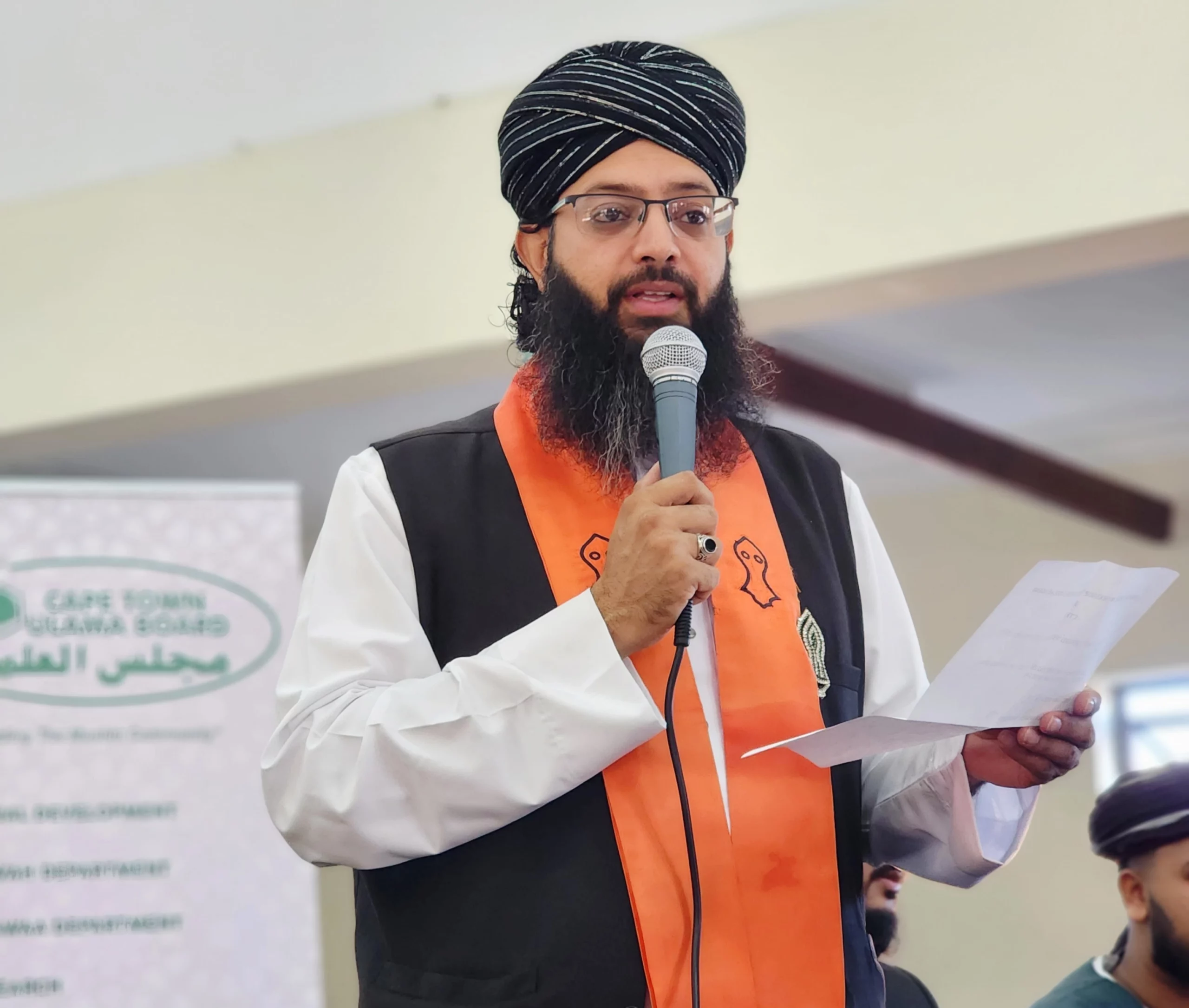
MOULANA SAYED IMRAAN SHAH ZIYAEE is the principal of Cape Town Islamic Educational Centre (CTIEC) as well as the deputy president of the Sunni Ulama Council Cape. He is a recognised spiritual guide in Cape Town for the Ziyaee, Ashrafi, Idreesiya and Qaderi Razvi Sufi orders.
- This article was first published in the March 13, 2026 print edition of Muslim Views.