




































“The historical tragedy is that the Congress Movement, which claims to have led the struggle for national liberation, has also contributed to the political marginalisation of numerous revolutionary traditions that sought to take that liberation beyond the limits of capitalist democracy.”
By DR MPHUTLANE WA BOFELO
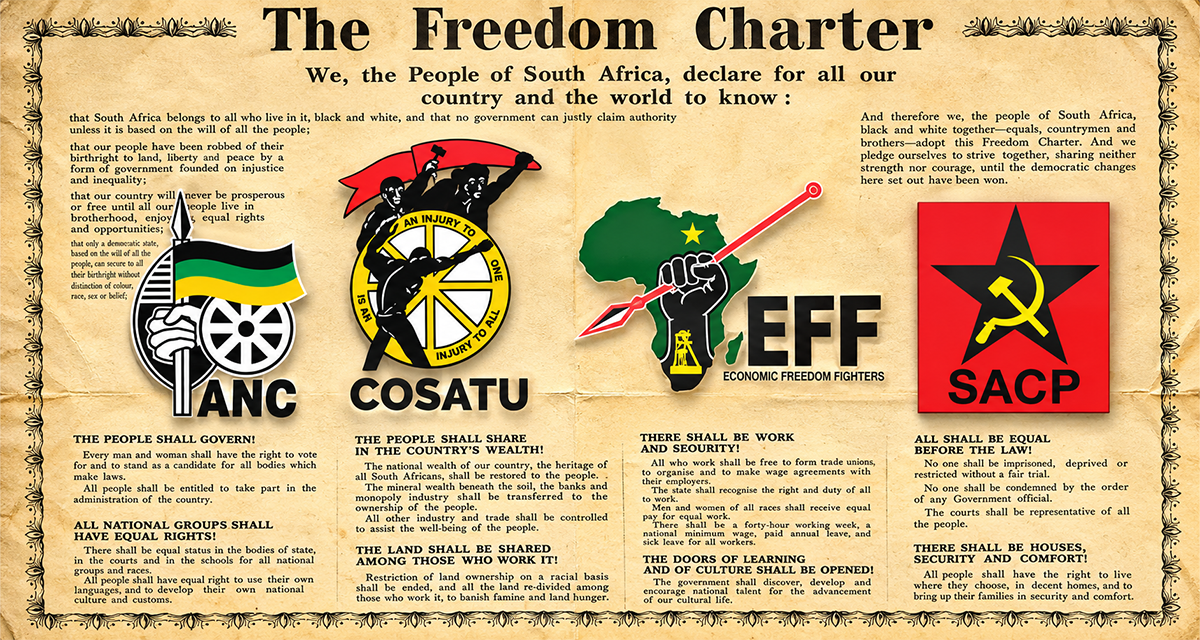
South African mainstream academia, political commentary and media discourse have developed a peculiar tendency to use the expression “the left” almost interchangeably with the South African Communist Party (SACP), the Congress of South African Trade Unions (Cosatu), and various political formations emerging from, or ideologically associated with, the Congress Movement, including the Economic Freedom Fighters (EFF).
This conceptual conflation is not merely an analytical oversight. It reflects a deeper ideological accommodation with the political traditions of the Congress Movement and its historical claim to represent the organised left in South Africa.
The problem with this categorisation is that it obscures fundamental ideological differences within the broader socialist, communist, anarchist, syndicalist, Trotskyist, Maoist, Africanist and Black Consciousness traditions. It also reproduces, often uncritically, the Congress Movement’s own political mythology: that the African National Congress (ANC) represents the authentic national liberation movement, that the SACP represents the organised vanguard of the working class, and that the political programme associated with the Freedom Charter and the National Democratic Revolution (NDR) constitutes an indispensable transitional pathway towards socialism.
Yet the Freedom Charter and the two-stage theory of revolution underpinning the NDR are not synonymous with revolutionary socialism. The NDR, as developed and institutionalised by the ANC-SACP alliance, rests on the proposition that South Africa must first undergo a national democratic revolution, whose immediate tasks include dismantling Apartheid, establishing political democracy and transforming the racial composition of political and economic power. Socialism is then presented as a subsequent historical stage.
This framework effectively postpones the confrontation with capitalist social relations in favour of a supposedly progressive national democratic settlement. It assumes that a sufficiently transformed capitalist state, with a more representative political and economic elite, can constitute a meaningful historical breakthrough for the working class and the oppressed.
The central problem is that the transition from Apartheid to constitutional democracy did not fundamentally abolish the capitalist relations of production upon which racial domination had historically rested. Instead, political democratisation took place alongside the reproduction and restructuring of capitalist accumulation, property relations and class power. The racial composition of the political elite changed considerably, but the underlying structures of capitalist exploitation remained substantially intact.
The result was not the transcendence of racial capitalism but its reorganisation under a new political dispensation.
To imagine that there is an autonomous, revolutionary left within the Congress Movement is therefore to overlook the historical record of how competing left-wing traditions have been treated whenever they challenged the ideological authority, organisational centralism and political strategy of the ANC-SACP alliance.
There is a substantial history to be written about the political repression, expulsions, factional purges, organisational exclusions and physical violence directed against individuals and collectives who attempted to advance alternative revolutionary programmes within or around the Congress Movement. This history fundamentally complicates the romanticised picture of the ANC-SACP alliance as the natural home of South African revolutionary politics.
Long before the establishment of the Communist Party of South Africa (CPSA) in 1921, South Africa possessed a vibrant radical working-class tradition influenced by revolutionary syndicalism, anarchism and international socialist currents.
Organisations such as the International Socialist League (ISL) and the Industrial Workers of Africa (IWA) played important roles in developing an anti-capitalist politics that challenged both racial domination and capitalist exploitation. These movements sought to organise workers independently of parliamentary politics and conventional nationalist leaderships.
Their political imagination was considerably broader than the later organisational framework of orthodox Marxism-Leninism. Revolutionary syndicalists and anarchists emphasised direct action, workers’ self-organisation, industrial solidarity and the revolutionary capacity of workers themselves.
The Russian Revolution of 1917, however, fundamentally altered the ideological landscape of the international socialist movement. The growing influence of Bolshevism and the Communist International (Comintern) promoted a model of revolutionary organisation characterised by democratic centralism, party discipline and ideological conformity.
When the CPSA was established in 1921, the emerging communist movement increasingly aligned itself with this international Leninist framework. Libertarian socialist and syndicalist traditions consequently lost organisational autonomy and were progressively displaced from the institutional centre of South African communism.
This was an important historical rupture. The emergence of the CPSA did not simply consolidate the existing radical labour movement under a new organisational banner; it also represented the ascendancy of one particular conception of revolutionary politics over competing socialist traditions.
The consequences were profound. Anarchist and syndicalist currents were marginalised, while the Leninist conception of the revolutionary party increasingly became the dominant organisational model of the South African left.
During the late 1920s and early 1930s, the CPSA experienced a profound ideological and organisational transformation under the growing influence of Stalinism and the Communist International.
The party became increasingly subordinated to the strategic priorities and ideological requirements of Moscow. Internal disagreements that might previously have been understood as legitimate political differences were increasingly interpreted as manifestations of factionalism, ideological deviation or disloyalty to the international communist movement.
Veteran communists, including SP Bunting and WH Andrews, were removed from positions of influence and expelled during the party’s Stalinisation. ER Roux, although subsequently an important communist intellectual, also became associated with the internal conflicts and political realignments of this period.
These developments were not simply administrative disputes. They reflected the consolidation of a political culture in which ideological conformity and organisational obedience increasingly took precedence over independent political judgement.
The emergence of Trotskyist organisations in South Africa must be understood within this context. Expelled and dissident communists contributed to the development of organisations such as the Lenin Club and the Workers Party of South Africa.
The fundamental disagreement concerned the character and trajectory of the South African revolution.
While the Stalinist communist tradition increasingly embraced the two-stage conception of revolution, Trotskyists argued that the democratic and national questions could not be separated mechanically from the struggle against capitalism. Drawing on the theory of permanent revolution, they maintained that the working class had to develop its own independent political power rather than subordinate its historical interests to a supposedly progressive nationalist or bourgeois leadership.
For Trotskyists, national liberation without a socialist transformation risked reproducing class exploitation under a different political leadership.
This disagreement was not merely theoretical. It concerned the question of which class would lead the revolutionary process, which organisations would exercise political authority and whether workers would retain their independent political agency.
The subsequent marginalisation of Trotskyist currents from the dominant Congress Alliance structures reflected this fundamental strategic conflict.
The conflict between the ANC and Africanist currents constituted another important chapter in the struggle over political authority within the liberation movement.
The adoption of the Freedom Charter in 1955 intensified disagreements over the ideological direction of the ANC. Africanist critics increasingly viewed the emerging Congress Alliance as an organisational arrangement in which African nationalism was being subordinated to a multiracial political project heavily influenced by white liberals and so-called communists.
The Africanists, associated with figures such as Robert Sobukwe and Potlako Leballo, challenged what they regarded as the growing ideological dominance of the SACP within the liberation movement.
Their disagreement concerned more than the racial composition of the Congress Alliance. It involved competing understandings of national liberation, African political agency, class relations and the relationship between national oppression and capitalism.
In April 1959, these disagreements culminated in the formation of the Pan Africanist Congress (PAC).
The Africanist breakaway exposed a fundamental contradiction within the Congress Movement: its claim to represent a unified national liberation project existed alongside deep ideological disagreements about the meaning of liberation and the political forces that should direct it.
The establishment of the PAC was therefore not simply an organisational split. It represented a rejection of the ideological and strategic direction that the ANC was increasingly consolidating.
The 1969 Morogoro Conference marked another decisive moment in the ideological consolidation of the ANC in exile.
The opening of ANC membership to non-Africans represented a significant organisational development. It also intensified longstanding tensions over the influence of the SACP within the liberation movement.
Prominent communists, including Joe Slovo and Yusuf Dadoo, occupied influential positions within the movement’s strategic and organisational structures, particularly the Revolutionary Council.
A group of Africanist dissenters challenged what they perceived as the increasing influence of the SACP and the erosion of African political leadership within the ANC.
Among those associated with this opposition were Tennyson Makiwane, Ambrose Makiwane and Alfred Kgokong Mqota.
The dispute eventually resulted in the expulsion of eight dissenters in 1975. The SACP’s intervention in the controversy, including its statement “The Enemy Hidden Under the Same Colour”, illustrated how ideological disagreements were increasingly framed through the language of factionalism, racialism and political subversion.
The significance of this episode lies in the way political disagreement was transformed into a question of organisational loyalty and ideological legitimacy.
Rather than accommodating competing revolutionary perspectives within a broad liberation movement, the dominant leadership increasingly treated dissent as a threat to organisational unity.
Perhaps nowhere were the contradictions of the Congress Movement more visible than in the struggles surrounding the resurgence of independent Black trade unionism during the 1970s and 1980s.
The emergence of independent worker organisations represented an important development in South African working-class politics. These organisations sought to build durable structures of worker organisation outside the control of established political formations.
The Federation of South African Trade Unions (Fosatu), established in 1979, became particularly important in this regard.
The workerist tendency associated with sections of Fosatu emphasised shop-floor organisation, workers’ control, democratic accountability and the political independence of the trade union movement.
Its proponents were suspicious of subordinating workers’ organisations to nationalist political leaderships. They feared that the incorporation of trade unions into a broader nationalist alliance would compromise working-class autonomy and subordinate socialist demands to the political priorities of an emerging political elite.
These concerns were not without historical foundation.
The formation of Cosatu in 1985 brought together important currents within the independent trade union movement, but it also marked the beginning of a longer process through which organised labour became increasingly integrated into the ANC-SACP political project.
The incorporation of organised labour into the Tripartite Alliance ultimately raised a fundamental question: could a trade union movement retain its independent working-class character while being politically aligned with a party whose programme prioritised a national democratic settlement within a capitalist framework?
The subsequent trajectory of Cosatu suggests that this contradiction was never satisfactorily resolved.
The ideological struggles within the ANC in exile also involved Trotskyist-influenced activists who challenged the strategic priorities of the organisation.
During the late 1970s, activists associated with the Marxist Workers’ Tendency and related currents, including Martin Legassick, Paula Ensor, Rob Petersen and David Hemson, criticised the ANC leadership’s strategic orientation.
They argued that the liberation struggle required a more systematic emphasis on mass working-class organisation and socialist politics rather than an overriding reliance on guerrilla warfare and military structures.
Their criticism challenged the assumption that the ANC’s political leadership should enjoy an uncontested monopoly over the strategic direction of the liberation struggle.
The conflict resulted in disciplinary action and the eventual exclusion of prominent activists from the ANC.
These developments reinforced a broader pattern: revolutionary socialists could participate in the Congress Movement only insofar as their politics did not fundamentally challenge its organisational authority, strategic orientation or conception of national liberation.
One of the most disturbing aspects of the ideological history of the Congress Movement concerns its relationship with Black Consciousness.
The political significance of Black Consciousness extended far beyond the personality and intellectual legacy of Steve Biko. It represented an alternative political philosophy centred on psychological liberation, Black self-determination, autonomous organisation and the rejection of the political dependency imposed by white liberalism and paternalistic political formations.
Black Consciousness challenged the assumption that the ANC and its associated organisations possessed an exclusive claim to represent the aspirations of Black people.
This was a direct ideological challenge to the Congress Movement’s political hegemony.
During the 1970s and 1980s, tensions between Congress-aligned activists and Black Consciousness organisations manifested themselves in intense political disputes, organisational hostility and, in some contexts, physical violence.
The political conflict became particularly acute during the resurgence of mass resistance in the 1980s, when competing political formations struggled for influence over communities, youth organisations and the broader anti-Apartheid movement.
It would be historically irresponsible to attribute every instance of violence during this period to a single organisation or political tendency. State repression, local political rivalries and the broader militarisation of resistance all contributed to the violence.
Nevertheless, the hostility directed at Black Consciousness activists by sections of the Congress Movement deserves serious historical investigation. So too do allegations of political killings, intimidation and the systematic delegitimisation of competing liberation traditions.
The portrayal of Biko as a CIA agent and the characterisation of Black Consciousness activists as agents of the Apartheid system exemplified a particularly pernicious political practice: the transformation of ideological disagreement into allegations of political treachery.
This was not an isolated rhetorical problem. It formed part of a broader political culture in which organisations outside the ANC’s ideological orbit could be portrayed as objectively serving the interests of Apartheid, irrespective of their actual political commitments.
Perhaps the most effective instrument through which the Congress Movement consolidated its ideological authority was the systematic deployment of the label ultra-left.
Trotskyism, Maoism, anarchism, syndicalism, Africanism and Black Consciousness were frequently treated not as distinct political traditions deserving serious intellectual engagement, but as ideological deviations from the supposedly correct line of national liberation.
The category of ultra-leftism became a convenient political weapon.
Anyone who questioned the ANC’s political leadership, challenged the SACP’s conception of the national democratic revolution, defended independent working-class organisation or rejected the subordination of socialist politics to nationalist priorities could potentially be dismissed as an ultra-leftist.
The implication was that revolutionary politics outside the Congress Alliance was not merely mistaken but politically irresponsible, sectarian or objectively beneficial to Apartheid.
This rhetoric performed an important political function. It established the ANC-SACP alliance as the presumed centre of legitimate revolutionary politics while delegitimising alternative conceptions of socialist transformation.
In this ideological environment, Marxism-Leninism increasingly became synonymous with Stalinist organisational practices: centralism without meaningful internal democracy, ideological conformity, unquestionable leadership authority and the subordination of working-class autonomy to the strategic interests of the party.
The distinction between Marxism as a critical tradition of emancipatory thought and Stalinism as a particular historical system of political organisation was consequently obscured.
The contemporary political significance of this history becomes clearer when examined against the trajectory of the post-Apartheid settlement.
The ANC-SACP alliance continues to defend the National Democratic Revolution as the principal framework for understanding South Africa’s political transformation.
You may also want to read


However, the NDR has increasingly functioned as an ideological justification for political accommodation with capitalism.
Its two-stage conception of revolution allows the postponement of socialist transformation in the name of consolidating national democracy. The immediate tasks of political transformation are elevated above the structural transformation of capitalist property relations.
In practice, this has facilitated the emergence of a political arrangement in which Black political representation, affirmative action, elite economic participation and constitutional democracy can be presented as evidence of revolutionary progress even when the material conditions of the working class remain fundamentally unchanged.
This is not to suggest that the democratic gains achieved through the defeat of Apartheid were insignificant. The dismantling of formal Apartheid legislation, the expansion of political rights and the establishment of universal suffrage represented important historical victories.
The problem is the tendency to treat these achievements as proof that the national democratic revolution has a necessarily progressive relationship with socialism.
A political settlement that preserves capitalist ownership, reproduces wage exploitation and leaves the majority dependent on the sale of their labour power cannot be mistaken for socialist transformation simply because the state and political elite have undergone racial restructuring.
The EFF, despite its more radical economic rhetoric, also operates within much of the inherited political vocabulary of the Congress tradition. Its invocation of the Freedom Charter and the national democratic revolution illustrates how deeply this framework has penetrated South African political discourse, even among organisations that present themselves as alternatives to the ANC.
The question, therefore, is not whether the Congress Movement contains individuals who sincerely identify as socialists or communists. It undoubtedly does.
The question is whether the ideological and organisational framework of the Congress Movement provides the conditions for an autonomous revolutionary left capable of challenging capitalism and the political authority of the nationalist leadership.
Historically, the evidence points in the opposite direction.
South Africa’s radical political history is considerably richer than the narrow historical narrative that places the ANC and SACP at its centre.
It includes the revolutionary syndicalists and anarchists of the early twentieth century; the Trotskyists who challenged Stalinist orthodoxy; the Africanists who rejected the subordination of African political agency; the Black Consciousness movement that insisted on autonomous Black political organisation; the workerists who defended independent working-class politics; and the various socialist currents that refused to subordinate their programmes to nationalist leadership.
These traditions were not ideologically identical. They disagreed profoundly over questions of race, class, nationalism, imperialism, organisation and revolutionary strategy.
Their significance, however, lies precisely in the fact that they represented alternative possibilities for political emancipation.
Their historical marginalisation has helped produce a distorted understanding of the South African left, in which the Congress Movement is treated as the natural custodian of socialist politics and the SACP as its unquestionable intellectual authority.
This historical narrative must be challenged.
There is nothing inherently revolutionary about belonging to the ANC-SACP tradition. There is nothing inherently socialist about invoking the Freedom Charter. Nor does the adoption of radical economic rhetoric automatically transform a nationalist political formation into an organisation of revolutionary working-class politics.
The left cannot be defined simply by its relationship to the Congress Movement, its historical contribution to the anti-Apartheid struggle or its continued invocation of the national democratic revolution.
It must be evaluated in terms of its actual relationship to capitalist social relations, working-class independence, democratic organisation and the struggle against all forms of exploitation and domination.
Ultimately, the central ideological question is whether socialism is understood as an independent historical project of working-class emancipation or as a distant possibility permanently deferred until the nationalist leadership has completed its supposedly unfinished democratic revolution.
For as long as the latter conception dominates, the South African left will remain trapped within the political imagination of the Congress Movement.
The historical tragedy is that a movement which claims to have led the struggle for national liberation has also contributed to the political marginalisation of numerous revolutionary traditions that sought to take that liberation beyond the limits of capitalist democracy.
The task, therefore, is not to discover the supposedly authentic left within the Congress Movement. It is to recover, reconstruct and advance the independent histories and political possibilities of the South African left outside the ideological and organisational boundaries imposed by Congress nationalism and Stalinist orthodoxy.
Dr Mphutlane wa Bofelo is a scholar and researcher in governance and political transformation, specialising in development politics, public leadership, popular politics and worker education.


