
























![The market-builder who restrained the market [Part 2]](https://muslimviews.co.za/wp-content/uploads/2026/08/PHOTO-2026-08-25-17-16-32-360x180.jpg)
![The merchant preceding the Prophetic mission [Part 1]](https://muslimviews.co.za/wp-content/uploads/2026/08/01-360x180.jpg)







Labarang is more than Eid — it is a living Cape Muslim tradition shaped by history, memory and community, carried across generations through faith and practice.
By ADLI YACUBI & ANWAR OMAR
LABARANG is often spoken of as a date on the calendar — the end of Ramadan or the culmination of the Hajj season — but for Cape Muslims it has always been something more enduring and more intimate. It is not simply an event, nor merely a religious obligation. Labarang is a lived institution: a woven practice of sound, taste, language, labour, memory, and belonging that has survived slavery, dispossession, segregation, and modern transformation.
Unlike tangible heritage — buildings, artefacts, or monuments — Labarang lives in repetition and relationship. It is carried through kitchens and tailoring rooms, through early morning takbīr sung in a distinct Cape melody, through shared meals, slaughtered animals distributed among neighbours, and family gatherings that stretch across households and generations. It is remembered not only through celebration but also through moments of grief and resistance, when sound and ritual held communities together under pressure.
This article understands Labarang as intangible cultural heritage in the fullest sense: not frozen tradition, but a dynamic, embodied inheritance shaped by history and reshaped by circumstance. Drawing on historical experience, linguistic memory, and lived practice, it traces how Labarang has travelled across eras — from the silence of enslavement to public visibility — and why its meaning cannot be reduced to ritual alone.

What is Labarang? Language, meaning, and distinction
The word Labarang itself carries layered histories. Like kaparang, piesang, and mieyang, it belongs to a family of Cape words shaped by contact between Malay, Arabic, Afrikaans, and creolised forms of speech. Yet Labarang differs from these terms in an important way: while the others name tangible objects, Labarang names a state of collective becoming.
In Cape Muslim usage, Labarang refers not to one moment but to two related yet distinct periods. Labarang Puasa marks the completion of Ramadan, while Labarang Hajji coincides with the Hajj season and the ritual of sacrifice. Though often collapsed into a single idea of ‘Eid’, these moments historically carried different emphases: one focused on restraint and release, the other on offering, distribution, and obligation to others.
What unites them is not chronology but texture — the sensory and relational practices through which faith becomes social life.
Alongside mosque-based rituals, Labarang was also carried through intimate, mobile practices. One enduring tradition involved small groups moving from house to house through the night and early morning, reciting the takbīr. Families waited with doors open and lights on, welcoming the sound into their homes. Sweet and savoury treats were shared, and children received small coins (later known elsewhere as Eidi or Labarang geld) — gestures of generosity remembered across generations. This circulation of sound, hospitality, and care linked households into a moral community, allowing Labarang to travel across neighbourhoods and, later, across the distances created by forced removals and diaspora. In this way, Labarang lived not only in fixed spaces but in movement itself.
Sound as heritage: Takbīr and the Cape laaghoe
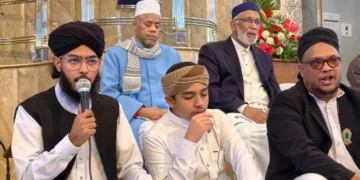
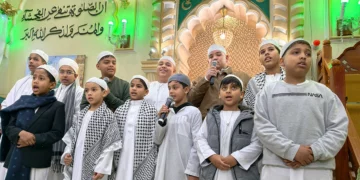
Among the most distinctive expressions of Labarang is the takbīr, recited audibly from the night before Eid and especially on its morning. While takbīr is a prophetic practice across the Muslim world, the Cape developed its own recognisable laaghoe — slow, melodic, and tinged with melancholy.
This was not accidental. Sound became a carrier of memory where written archives were denied. The Cape takbīr does not rush towards celebration; it lingers. It holds joy and sorrow together, allowing gratitude to coexist with loss.
That quality became powerfully evident during the 1980s, when this same takbīr was used at mass janāzah gatherings, including after the killing of Ebrahim Carelse in Salt River. In those moments, Labarang’s soundscape crossed into public mourning and resistance, affirming dignity when other forms of expression were constrained.
Here, Labarang reveals itself not as festivity alone but as moral presence.
You may also want to read


Labarang in the slave era – Faith without institutions
Long before mosques, minbars, or public processions, Islam in the Cape survived as an intimate and disciplined inheritance — carried by enslaved people whose faith had been severed from institutions but not from memory.
Early Islamic life at the Cape took shape through figures such as Shaykh Yūsuf ibn Ayyūb al-Maqassarī, remembered as Tuang Yusuf of Macassar, who was exiled by the Dutch and confined to Zandvliet near present-day Faure. Though isolated, his presence quietly shaped religious life. He taught students, modelled devotional discipline, and transmitted core practices — ṣalāh, ṭahārah, Qur’anic recitation — within conditions of surveillance and exile.
This inheritance was later consolidated through Imām ‘Abdullāh ibn Qāḍī ‘Abd al-Salām, known as Tuang Guru, whose imprisonment on Robben Island and later establishment of the first mosque formalised practices already living in homes, kitchens, and workspaces. Through him and his students, the Shāfiʿī madhhab became embedded in Cape Muslim ritual life — shaping how prayer was performed, how Ramaḍān was observed, and how Labarang was marked.
During the slave era, Labarang unfolded without public visibility. There were no mass prayers or open celebrations. Takbīr was recited softly, often within homes or small gatherings; food was shared quietly among families; joy was held with restraint. Yet this was not absence — it was adaptation. Labarang survived as practice without procession, as faith carried through bodies rather than buildings.
In these conditions, Labarang became more than a date on the calendar. It was an act of inward sovereignty — a way of affirming dignity, continuity, and belonging when freedom itself was denied. Long before it entered public space, Labarang was rehearsed in silence, memory, and devotion — sustained by people who refused to let faith disappear simply because it could not yet be seen.
From emancipation to apartheid – Labarang in public, under constraint
The abolition of slavery in the nineteenth century marked a decisive shift in how Labarang was lived at the Cape. Freed from absolute confinement, Muslims began to practise their faith with greater visibility, though still within deeply unequal conditions. Labarang slowly moved from the private sphere into public life — not as spectacle but as careful emergence.
Mosques became anchors of communal rhythm. Eid prayer, once dispersed and discreet, could now be performed collectively. The takbīr was voiced more openly, its cadence shaped by Cape sensibilities — deliberate, measured, and resonant. Families prepared for Labarang with intention: garments sewn by local tailors and dressmakers, food prepared collectively by women across households, and meat from Labarang Hajji shared beyond immediate kin. These were not simply customs; they were acts of social repair after generations of fracture.
Urbanisation intensified this process. As Muslims settled in areas such as District Six, Bo-Kaap, and Salt River, Labarang took on a distinctly communal texture. Eid prayers were sometimes held outdoors, in open fields or communal spaces, reinforcing the sense that Labarang belonged not only to the mosque but to the neighbourhood. Extended family gatherings became central, binding households together through shared meals, visits, and remembrance.
Under apartheid, however, this public visibility existed under restriction. Forced removals, racial zoning, and surveillance fractured long-established communities. Mosques were separated from congregants; families were dispersed across distant townships. Yet Labarang endured — not through resistance alone but through continuity. Rituals adapted to new geographies: prayers reorganised, food shared across distances, visits planned despite transport barriers.
After the destruction of District Six and the removals from parts of Wynberg and Claremont, Muslim communities were pushed far from the city’s historic religious centres. In the Cape Flats — in areas such as Bonteheuwel, Manenberg, Hanover Park, and Mitchell’s Plain — mosques had to be built again, often with limited resources and immense communal effort. Labarang travelled with these displaced communities, re-rooting itself in new landscapes. Eid prayer, takbīr, food-sharing, and family gathering reassembled around newly established mosques, further from the city but no less anchored in inherited practice.
In these years, Labarang became a quiet assertion of presence. It affirmed community in the face of fragmentation and dignity under systems designed to erode it. Even moments of collective grief — such as mass funerals during political violence — drew on the emotional register of Labarang, including the familiar takbīr melodies whose solemnity carried both sorrow and steadfastness.
From emancipation through apartheid, Labarang did not simply survive historical change; it absorbed it. Each constraint reshaped the practice but never dissolved it. What emerged was a form of intangible heritage forged through adaptation — a living institution sustained not by permission but by practice.
Post-apartheid – Visibility, change, and new pressures
From the late 1980s, another public expression of Labarang began to re-emerge: the revival of Eid prayer held outdoors in Eidgahs. Initially modest and localised, these gatherings grew more visible in the post-apartheid period, symbolising both religious confidence and reclaimed public space. While not adopted everywhere, Eidgah prayers marked a renewed willingness among Cape Muslims to pray openly, collectively, and without apology.
At the same time, Cape Muslim life had long extended beyond the Cape itself. For decades, families had migrated — in smaller but steady numbers — to cities such as Port Elizabeth, Mossel Bay, Kimberley, Johannesburg, and Durban. Labarang travelled with them. Though practices adapted to new environments, timing, and community scale, the core rhythms endured: takbīr, prayer, food-sharing, and visitation. These dispersed communities maintained a sense of connection to Cape Muslim custom while contributing to a wider, quietly interconnected South African Muslim landscape.

Conclusion: Labarang as living inheritance
Labarang endures not because it was preserved unchanged, but because it was practised with care. Across slavery, emancipation, forced removals, and democratic transition, it survived as a lived inheritance — carried through sound, food, prayer, dress, and obligation rather than secured by buildings or formal recognition.
It moved with people: whispered under restriction, re-rooted in the Cape Flats after displacement, voiced in Eidgahs when public space opened again, and carried beyond the Cape to other South African cities. Each shift reshaped its expression without breaking its meaning.
At its heart, Labarang is not only celebration. It is restraint unfolding into generosity, private devotion made communal, and memory renewed through repetition. To recognise Labarang as intangible heritage is not to fix it in time, but to honour the communities who continue to transmit it — quietly, faithfully, and together — year after year.
- This article was first published in the March 13, 2026 print edition of Muslim Views.