


















![The market-builder who restrained the market [Part 2]](https://muslimviews.co.za/wp-content/uploads/2026/08/PHOTO-2026-08-25-17-16-32-360x180.jpg)
![The merchant preceding the Prophetic mission [Part 1]](https://muslimviews.co.za/wp-content/uploads/2026/08/01-360x180.jpg)






The people of Belhar and Delft live out a daily Arafah, raising their hands not in ease, but in struggle, calling out to the Most Merciful while burdened by poverty, neglect, and violence. When the world overlooks places like Belhar, its people continue to affirm life, justice, and human worth, refusing to be erased, refusing to give up.
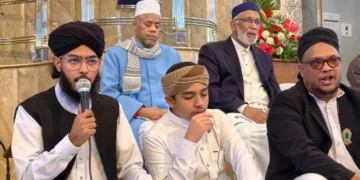
Khutbah delivered at the Owwal Masjid in Belhar, Cape Town on Friday May 23, 2025.
By PROFESSOR ASLAM FATAAR
Alhamdulillah. All praise is due to Allah, who made the Hajj a sanctuary of return, a school of purification, and a path of moral awakening. Peace and blessings upon our master Muhammad (peace be upon him), who taught us the Hajj , and whose heart encompassed humanity with mercy, wisdom, and truth.
As Muslims worldwide prepare for the sacred days of Dhul Hijjah, a quiet yearning stirs in those who remain behind. The pilgrimage to Makkah, the fifth pillar of Islam, is not just a journey. It is a profound encounter, a moral reorientation, and a bodily dialogue with the Divine. However, the Hajj is not only expressed in Makkah. Its moral energy must take root in our lives, in Belhar, Delft and Langa.
The Hajj begins on the 8th of Dhul Hijjah in Mina and peaks on the 9th at Arafah. There, pilgrims stand before God in complete surrender. The Prophet (SAW) said, ‘The Hajj is Arafah.’ It is the essence of the pilgrimage: a moment of standing, repentance, and being completely exposed before the Divine. Arafah renews the believer, not just ritually but spiritually and morally.
But this wuquf, this standing, is not only for those on the desert plains of Makkah. Each of us has our own Arafah, recognition, experiential knowledge of Allah, and realisation of our life’s purposes. It may come in solitude, suffering, prayer, or realising how far we’ve strayed.
It is the moment we utter the supplication of Adam and Hawwa after their transgression, as if upon our plain of Arafah: ‘Our Sustainer! We have sinned against ourselves, and unless Thou grant us forgiveness and bestow Thy mercy upon us, we shall most certainly be lost!’ (Surah Al-A’raf, 7:23)
This moment of forgiveness, realisation, and return is not only a personal reckoning. It is also a collective stance of faith and dignity. In Belhar, far from the sacred plains of Arafah, people stand within a country trying to make good on the brokenness left by apartheid, yet facing complex and enduring challenges along the way.
And yet, like the people of Palestine, they embody sumud, a steadfastness that is both spiritual and moral. The people of Belhar and Delft live out a daily Arafah, raising their hands not in ease, but in struggle, calling out to the Most Merciful while burdened by poverty, neglect, and violence. When the world overlooks places like Belhar, its people continue to affirm life, justice, and human worth, refusing to be erased, refusing to give up.
After Arafah, pilgrims proceed to Muzdalifah, which the Quran refers to as al-Mashʿar al-Haram: ‘Then when you flow down from Arafah, remember Allah at al-Mashʿar al-Haram.’ (Surah Al-Baqarah, 2:198)
Beneath the open sky, they rest, reflect, gather stones and prepare for the next stage. Muzdalifah is a station of stillness before struggle, an act of spiritual readiness. It teaches us to pause, to breathe, and to place our trust in Allah before moving forward.
We, too, need our Muzdalifah moments, pauses of stillness in a world overwhelmed by pressure and distraction. These are the moments that ready us for principled, moral action. In places like Gaza, Bo-Kaap, Khayelitsha, and right here in your homes in Belhar, faithful communities draw strength by pausing to pray, reflect, and seek the protection of Allah. In doing so, they enact sacred acts of resistance, quiet yet powerful affirmations of faith and resilience.
Next comes Ramy al-Jamarat, the casting of stones at symbols of evil. The pilgrim rejects arrogance, injustice, fear, and apathy with each pebble. This is not mere symbolism. It is moral refusal. The Quran says, ‘But as for those who strive hard in Our cause – We shall most certainly guide them onto paths that lead to Us: for, behold, God is indeed with the doers of good. (Surah Al-’Ankabut, 29:69)
Ramy, pelting the Jamarat, challenges us to cast away what darkens the soul and harms others: racism, xenophobia, selfishness, moral fatigue, and silence in the face of oppression. It reminds us that faith is not passive. It is an active struggle.
The oppressed of the world perform this Ramy daily. We live sumud through the planting of trees, the sheltering of the wounded, and the teaching of children in our madrasahs and schools. Our strength is ihsan in action.
You may also want to read


After Ramy, the pilgrim returns to the Kaabah to perform Tawaf al-Ifadah, circling the sacred centre of Islam. This powerful act symbolises the reorientation of one’s life around the Divine. It calls each of us to ask: what truly lies at the centre of our lives? Is it ego, desire, wealth—or is it Allah?
The Quran offers a resounding answer: ‘Say: My prayer, my sacrifice, my life and my death are for Allah, the Lord of the Worlds’. (Surah Al-An’am, 6:162)
The act of Tawaf around the Kaabah reminds us that our lives are meant to orbit the eternal, not the fleeting. It draws us away from illusions of ego, self and worldly gain, and calls us, again and again, back to the centre of our moral and spiritual being.
Then comes Saie, the running between Safa and Marwah in honour of Hajar’s search for water. She did not know the outcome but ran with faith, desperation, and trust. Her striving was sacred. So too is our daily striving, raising children, building our communities, and resisting injustice. Often, we do not see the outcome, but the effort itself, done with sincerity, is sacred.
Every small act, cleaning a waterlogged home after heavy rain, serving boiling tea to the infirm, opening a school, is our Saie, a striving marked by divine presence. As the Quran assures, ‘Indeed, with hardship comes ease’. (Surah Ash-Sharh, 94:6)
From Hajar’s desperation came Zamzam. From their struggle may come justice.
So, dear believers at Belhar Owwal Masjied, let us carry these sacred lessons with us:
- Our Arafah is our moment of return.
- Our Muzdalifah is our pause in trust.
- Our Ramy is our defiance of injustice.
- Our Tawaf is our realignment with Divine purpose.
- Our Saie is our hopeful striving in service.
Let our lives reflect ihsan, beauty, presence, and excellence. Let our moral becoming and practices be purified by remembrance, compassion, and solidarity with all who suffer.
In an age marked by ecological collapse, war, injustice, and moral confusion, the Hajj offers more than ritual. It gives us a structure for moral renewal. It teaches us how to return, trust, centre, resist, and strive.
This is the Hajj that never ends. May we live it in our daily lives. And may we walk it, in spirit and struggle, with the people of Belhar, Palestine, Kashmir, and all other places under the yoke of suffering and vulnerability. Ameen.