





























A woman in a 1925 Cape Malay Conference photograph, published in Muslim Views, draws Adli Yacubi into family memories, handwritten names and the history of Cape Muslim women. Her identity remains uncertain, but the search is revealing new stories and connections.
By ADLI YACUBI
The first thing I noticed was the woman in the middle.
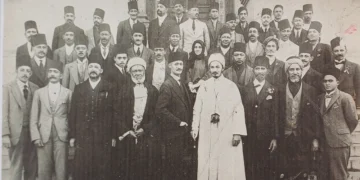
Omar Gallie had shared a photograph of the 1925 Cape Malay Conference. He could point out his great-great-grandfather, the man with the grey beard and white turban towards the left. In the comments, other people began placing their own relatives. A grandfather in the back row. A granny’s brother with a white scarf around his neck.
I asked about the woman.
Omar said he’d probably looked at the photograph a hundred times and had never seen her. Hoelihaa, he said.
That made me laugh. If my great-great-grandfather was in that photograph, my eye would probably go straight to him too.
On the steps of Parliament House
Anwar Omar told me the photograph had come from his article in Muslim Views. Shamiel Gamildien had shared it with him. Anwar put us in touch.
Shamiel, it turns out, is from Primrose Park. I told him I’d lived at Olifants Street from 1972 to the end of the eighties. We’d begun with a photograph taken a century ago and were already talking about a neighbourhood we both knew.
When I asked about the woman, Shamiel said, “I will do better.” He sent a copy with names handwritten beneath the photograph.
Under the second row, I can make out “CT Ladies Branch” and Gamildien. The initials look like HO to Shamiel. I can also read the second one as a D. I caught myself wondering whether the H stood for Hajira, or whether it was a title. I’d already begun trying out names in my head.
The handwritten caption places the first annual conference of the Cape Malay Association in Cape Town on June 17, 1925, with the photograph taken on the steps of Parliament House. This differs from the June 11 date printed with Anwar’s article. I have followed the handwritten caption.
There she stood, in the middle of that gathering, with a ladies’ branch written beside her name. Who were the other women? What did they do together? What did they want discussed at that conference?

Every day?
Anwar’s article began with another question. He was investigating whether there had been mass burials at Mowbray Muslim Cemetery during the influenza epidemic of 1918. That enquiry led him to a pocketbook kept by Shamiel’s great-grandfather, Haji Samdon Gamildien, who also appears in the photograph.
Among its births, marriages and deaths are two pages tallying Muslim deaths in Cape Town during the flu.
Two on the first of October. One the next day. By the seventh, thirty-one. On the eleventh, sixty-eight.
You may also want to read





Anwar writes that at the height of the epidemic sixty or more Muslims were dying every day.
Every day? Every day?
I had to read it again. In all, the pages record 595 deaths in twenty-two days.
I knew what a janāzah was. I could picture people arriving at a house and asking what needed to be done. But how do you take in sixty-eight deaths in a single day? Who washed and shrouded the dead? Who dug the graves? How many of those people had someone ill or dying in their own house?
The tally leaves those questions open. It gives Anwar dates to work with as he searches burial records. Elsewhere, Haji Samdon recorded that his niece Fatiema died on Friday, 18 October, at 1.05pm. The entry gives no cause of death. Someone remembered the five minutes past one.
I asked Anwar about stories passed down in Cape families. My dad and my mom must have told us something. Perhaps they did and we weren’t really listening. Or maybe we forgot.
From the last date on the flu pages to the date handwritten beneath the photograph, it is less than seven years. Haji Samdon was there on the steps. So was the woman whose initials I’m still trying to read.
I don’t know where she was in October 1918, or what she remembered of it.
The scarf I thought I recognised
I had looked closely at her scarf. It sat around her face and fell over her shoulders. I thought of my mom. If she had put on a scarf for a posed photograph, she would have worn it in two layers. I remember that about her.
The plain way this woman wore hers reminded me of Indian women I’d seen in photographs. I wondered where she had learnt to wear it that way.
After I published the essay, Fatima Noordien wrote to me. Her Oemie had worn her scarf similarly. She also wondered whether the H might refer to the title Hadjie.
Her recollection gave me another family photograph to imagine alongside this one. My mother’s way of wearing a doek was familiar to me. Fatima remembered another way from her own family.
Then I saw Nawawie Mathews’s photograph of his elderly mother. Her scarf framed her face, crossed beneath her chin and lay over her shoulders. I thought again of the woman on the steps, and of the different ways Cape Muslim women have worn their scarves through the decades.
There is a story there too. The onderdoekie, the doek over it, the scarf knotted beneath the chin or left loose. How much do we remember about who wore what, and when?
Looking for her name
The responses brought more family memories. Soraya Harris Solomon identified her grandfather, Emaam Sulaiman Harris. She had been too young to remember him, but her father, Emaam Yaseen Harris, had spoken about this conference and others in which he had participated.
Shafiq Gamiet identified his grandfather, Arshad Gamiet, in the front, turned slightly to his left.
River Wyoming Yaffe suggested that the woman might be Siti Gamieldien, associated with the CMA’s ladies’ branch. I asked for the source. River explained that she had searched on the spur of the moment and had not recorded the reference. She is trying to recover it.
For now, that suggested identification remains unverified. We still need the passage and its source, and evidence connecting it to this photograph.
River has also shared avenues for further research, including the Western Cape Archives and obtaining copies ofMoslem Outlookthrough the National Library. The search continues.
Shamiel suggested approaching Aunty Abdeyah Da Costa, a 100-year-old woman in Bo-Kaap. My sister-in-law Najma helped make enquiries through her niece, Aunty Warda. The reply was tender and practical. Her sight made the photograph difficult to see, and what she might recall was unpredictable. Perhaps a visit could help.
I thought about the distance between being told that someone remembers and sitting beside them while they try.
Back to the photograph
I still cannot give this woman her full name.
I can say that the handwritten caption connects her to the Cape Town Ladies Branch. I can see where she stood. I can follow the responses of people who recognise their grandfathers, or remember what their parents told them.
When I meet Shamiel in Cape Town, I will take these questions with me.
Perhaps a family album holds another photograph of her. Perhaps there is a letter, a branch minute book, or a name written on the back of a print. Perhaps someone has heard her name all their life.
Omar saw his great-great-grandfather. I saw her.
Somewhere there may be someone who can look at the same photograph and say, “That’s our granny.”
Adli Yacubi is a South African writer, poet and designer whose work explores faith, memory, culture and resistance. A co-founder of the Call of Islam, he writes from his experience of the anti-apartheid struggle and a lifelong interest in the stories people carry. He is the author of Punching Above Its Weight and publishes essays and poetry on Substack. Born in District Six, Cape Town, he now lives in Johannesburg.


